
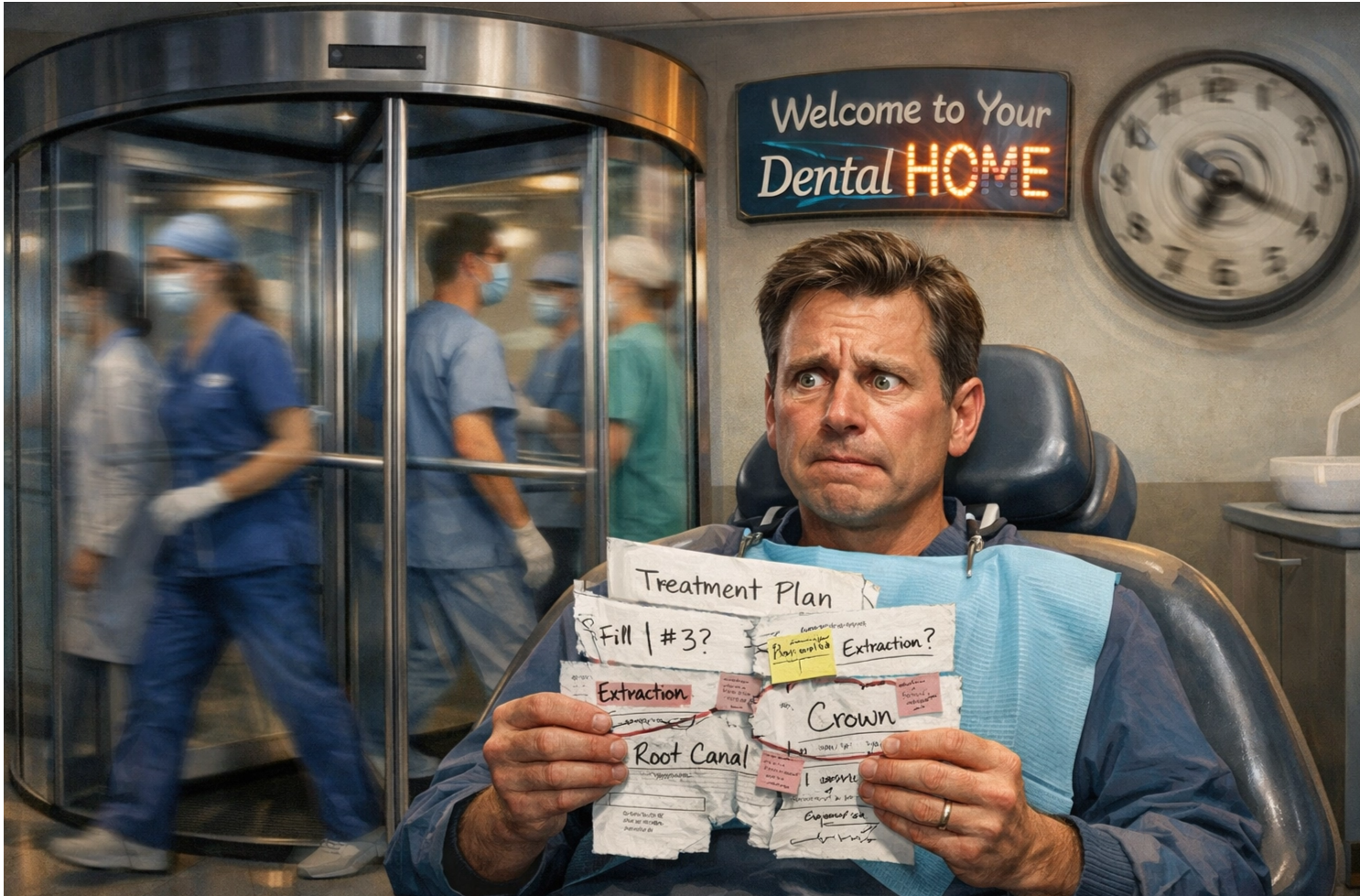
The Revolving Door: What Constant Provider Changes Mean for Your Oral Health
Core Reality
- Long-term healthcare depends on consistency
- Frequent staff turnover disrupts diagnosis, treatment planning, and trust
- This is not an internal HR problem. It directly affects patient outcomes
Why the Turnover Happens
- Corporate dentistry environments often involve:
- High production quotas
- Strict corporate treatment protocols
- Limited clinical autonomy
- High production quotas
- New dentists are frequently recruited with:
- Signing bonuses
- Student loan repayment assistance
- Signing bonuses
- Many clinicians leave once contracts end due to:
- Burnout
- Ethical conflicts
- Desire for independent practice
- Burnout
- Result:
- Constant onboarding of new providers
- Continuous loss of institutional and patient-specific knowledge
- Constant onboarding of new providers
How This Impacts Your Care
1. Lack of Continuity: Your Case Resets Every Visit
- Each new provider must relearn your history
- Charts often miss:
- Sensitivities
- Past complications
- “Watch-and-wait” problem areas
- Sensitivities
- Subtle clinical context is easily lost
- You are treated as a record, not an evolving case
2. Inconsistent Diagnosis and Treatment Philosophy
- Dentistry involves clinical judgment, not just checklists
- Different dentists may interpret the same condition differently:
- Conservative monitoring vs immediate intervention
- Conservative monitoring vs immediate intervention
- Production pressure can influence urgency of treatment recommendations
- This creates:
- Patient confusion
- Erosion of trust
- Risk of unnecessary procedures
- Patient confusion
3. Disjointed Multi-Phase Treatment Plans
- Complex treatments often span months:
- Implants
- Periodontal care
- Full-mouth restorations
- Implants
- One dentist may start the plan, another finishes it
- Differences may include:
- Technique
- Lab preferences
- Aesthetic standards
- Technique
- Outcomes can suffer both functionally and visually
4. Breakdown of Trust and Communication
- Trust develops through repeated interactions
- Frequent provider changes make it harder to:
- Ask questions
- Raise concerns
- Disclose discomfort or fear
- Ask questions
- Patients may disengage, leading to poorer outcomes
- Healthcare becomes transactional instead of relational
5. Administrative and Operational Errors
- High turnover is not limited to clinicians
- Front-office churn increases risk of:
- Scheduling mistakes
- Insurance claim errors
- Billing inconsistencies
- Scheduling mistakes
- These issues compound patient stress and dissatisfaction
What Patients Can Do to Reduce Risk
- Ask direct questions:
- “How long has this dentist worked here?”
- “Will I see the same provider throughout my treatment?”
- “How long has this dentist worked here?”
- For complex procedures:
- Request one dentist manage all phases
- Ask for this commitment to be documented
- Request one dentist manage all phases
- Maintain personal records:
- X-rays
- Treatment plans
- Periodontal charting
- X-rays
- Treat stability as a quality signal, not a bonus feature
Bottom Line
- High staff turnover undermines continuity, trust, and consistency
- It increases diagnostic variability and treatment disruption
- A revolving door often reflects a system optimized for short-term metrics, not long-term patient health
In healthcare, repetition builds insight. Constant replacement builds noise.